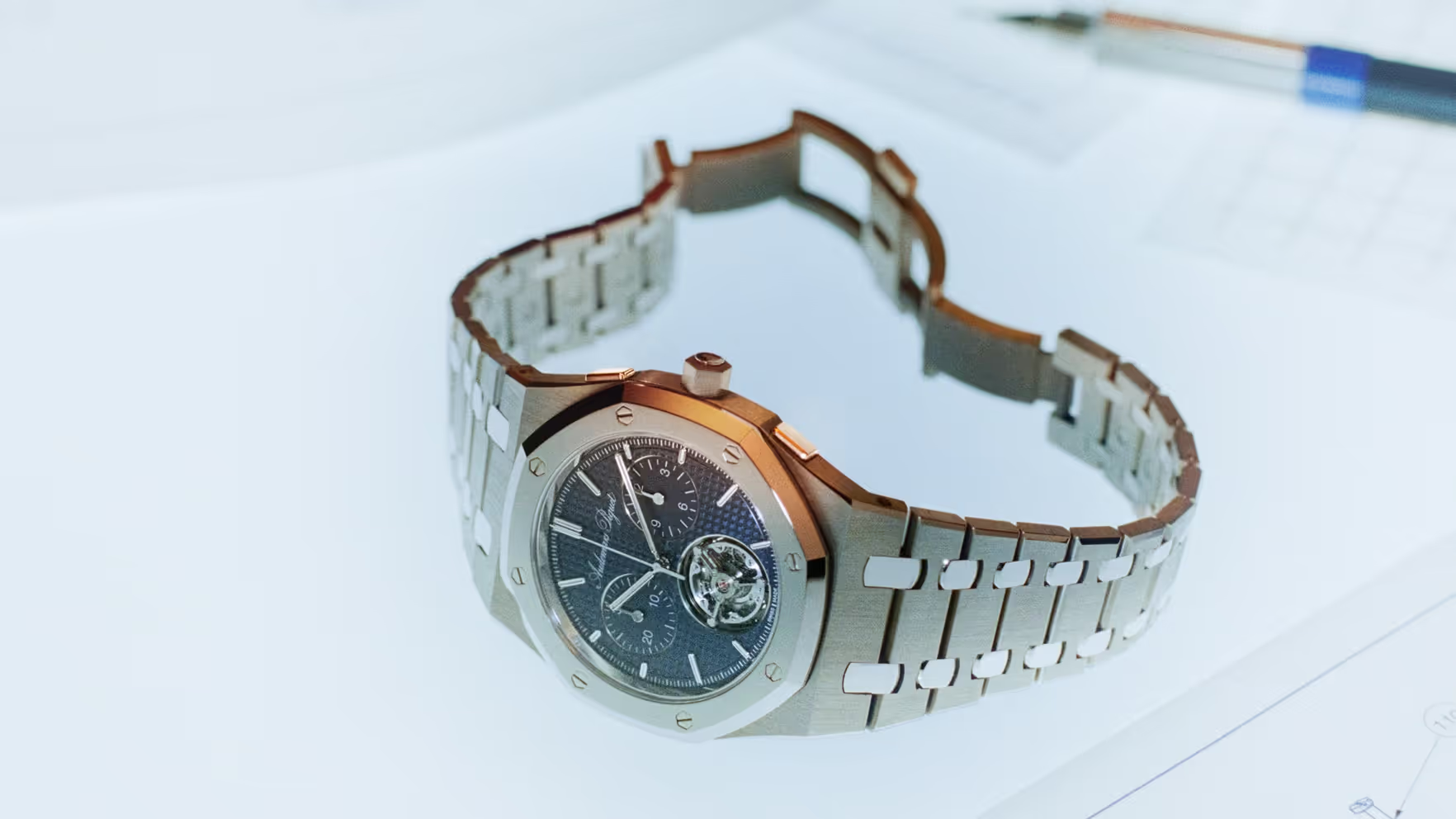
To mark its 150th anniversary, Audemars Piguet did not look backwards. Instead, it delivered the Royal Oak “Jumbo” Extra-Thin Selfwinding Flying Tourbillon Chronograph RD#5—a timepiece that feels less like a commemorative object and more like a manifesto.
Radical, intuitive and audacious, the RD#5 proposes that even the most entrenched mechanisms in haute horlogerie can be rethought from first principles.
The RD#5 is the grand finale of Audemars Piguet’s experimental “RD” (Research & Development) series, a decade-long project that has consistently challenged the assumptions underpinning complicated watchmaking.
Each instalment tackled a complication long considered immutable, and asked an uncomfortable question: what if we rebuilt it for the 21st century?

That journey began in 2015 with the RD#1 Supersonnerie, an acoustic breakthrough that addressed a problem as old as chiming watches themselves. Minute repeaters had always been at the mercy of their cases, their sound dulled or distorted by construction. The RD#1 Supersonnerie re-engineered the way gongs interacted with the case, anchoring them to a new resonating membrane that amplifies clarity, volume and purity. It was not about making a louder watch, but a more articulate one—proof that refinement, not excess, is the true measure of progress.
In 2018, the RD#2 took aim at the perpetual calendar, a complication revered for its intelligence, but notorious for its thickness and fragility. By reorganising all calendar functions into a single plane, Audemars Piguet flattened what had traditionally been a stacked, multi-layered mechanism. The result was the thinnest automatic perpetual calendar in the world at the time, housed within the familiar Royal Oak Jumbo case. Complexity, the RD#2 argued, need not announce itself through bulk.
Four years later, the RD#3 extended this philosophy to one of watchmaking’s most theatrical complications: the tourbillon. By integrating a flying tourbillon into an ultra-thin Royal Oak Jumbo, Audemars Piguet achieved something once thought contradictory. The high-amplitude, titanium-caged regulator did not compromise wearability or thickness, yet it delivered both technical gravitas and visual drama.
Then came the RD#4 in 2023, an astonishing technical exercise that housed forty functions within a single movement. More than a feat of density, the RD#4 was a demonstration of systems thinking—of how complications could coexist, communicate, and share energy efficiently. The RD#4 was less about any one function and more about orchestration, foreshadowing the holistic rethink that would define the RD#5.
That rethink centres on the chronograph, a complication whose origins stretch back to the early 19th century. Despite refinements such as the vertical clutch, flyback mechanisms, and split-seconds variations, the chronograph’s core architecture has remained remarkably static.
The hammer-and-heart cam system has long reigned supreme, demanding significant force—often around 1.5kg—to reset. It works, but had not seen such an elegant redesign until Audemars Piguet worked its magic.
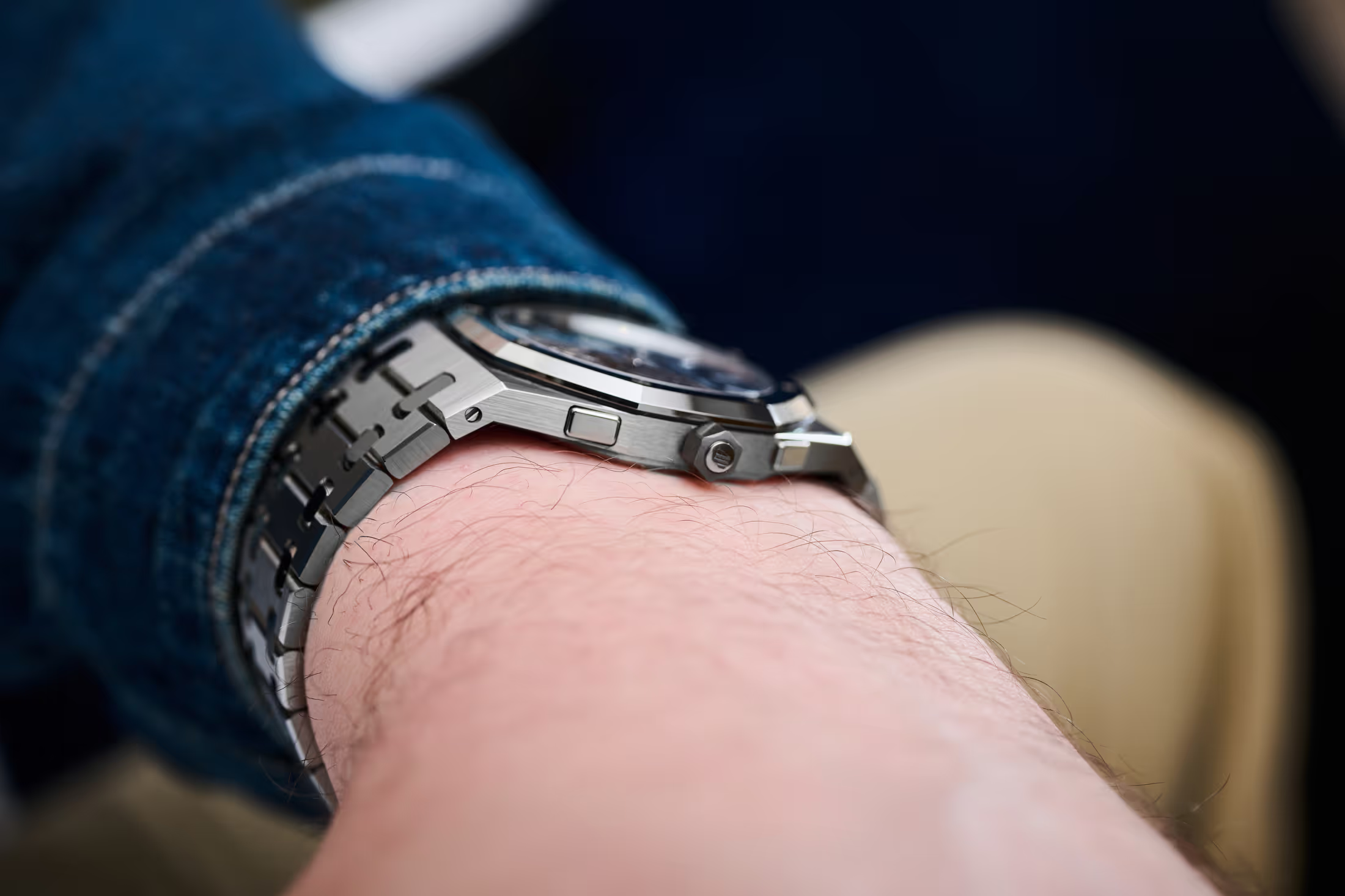
The RD#5 replaces brute force with finesse. At first glance, the most striking cue is what is missing: the Royal Oak chronograph’s traditional protruding pushers. Gérald Genta’s octagonal silhouette remains pristine and uninterrupted, save for the crown. In their place are discreet, shallow actuators integrated into the case flank—more akin to the tactile buttons of a smartphone than the pistons of a vintage stopwatch. Engaging its chronograph feels almost effortless.
This ease is no illusion. A patented rack-and-pinion system eliminates the heart cam entirely, replacing it with a mechanism that gently engages and disengages by sliding components towards or away from one another. Crucially, the system draws on energy from the running chronograph—energy that would otherwise be dissipated.
The result is an 80 per cent reduction in required force, a pusher travel of just 0.3mm, and a reset time of 0.15 seconds. The chronograph minute counter, too, has been reimagined: instead of creeping forward, it jumps instantaneously, powered by a return spring fed by reclaimed energy. For the first time in nearly two centuries, the chronograph has been fundamentally reinvented.
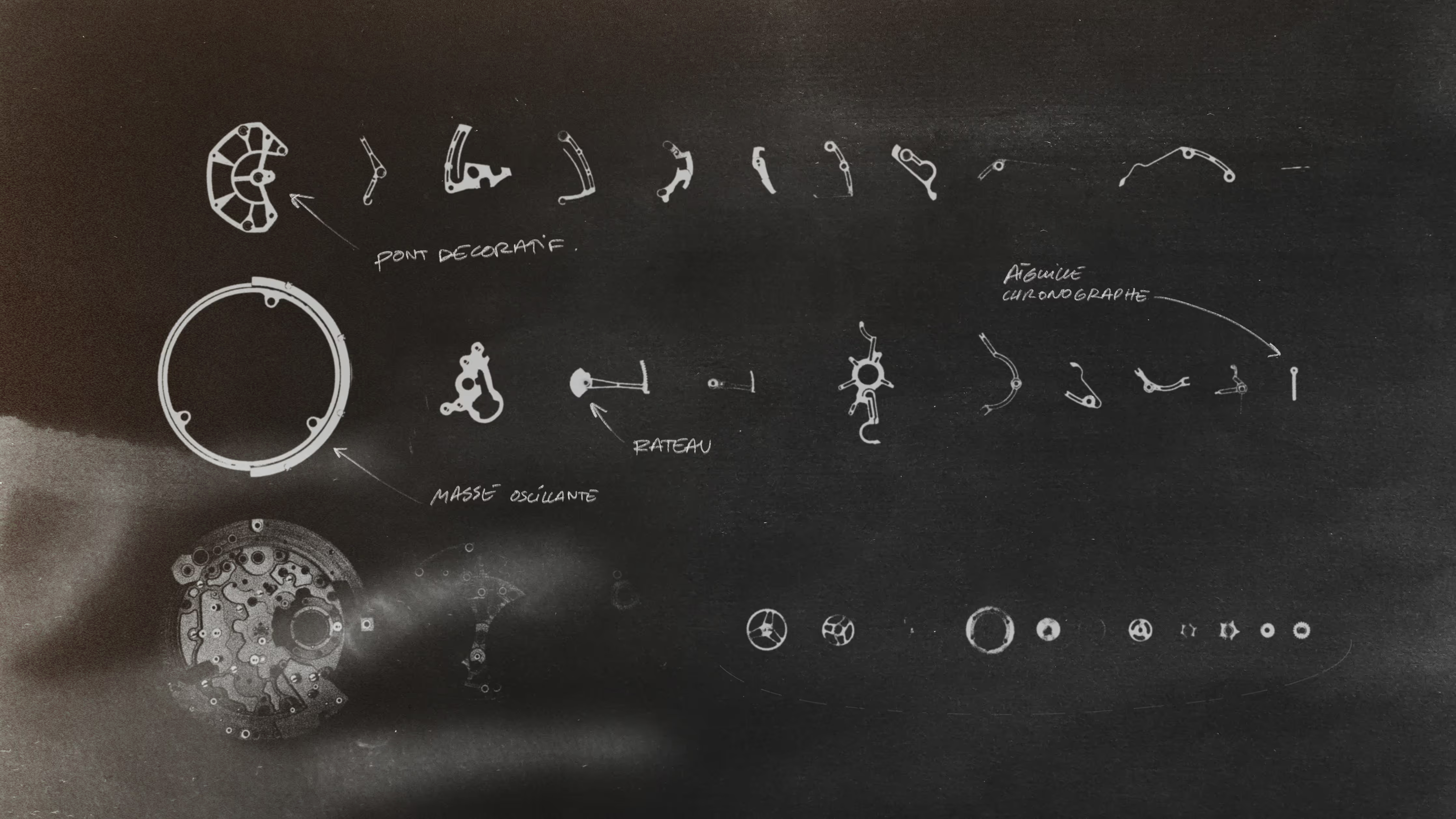
All of this is orchestrated by the new Calibre 8100, a movement just 4mm thick that combines a flyback chronograph with the high-amplitude flying tourbillon first explored in the RD#3. The traditional symmetry of Royal Oak chronographs gives way to a subtle recalibration: the sub-dials are raised slightly, allowing the lightweight tourbillon to command centre stage at 6 o’clock.
User-centric thinking extends to the crown itself. Rather than pulling it out to switch modes, a discreet pusher embedded within toggles between winding and setting. A red indicator confirms when the RD#5 is ready to be adjusted. It is a small gesture, but emblematic of the RD#5’s philosophy: complexity should not burden the wearer.
Behind this philosophy stands Giulio Papi, one of the most influential figures in contemporary watchmaking. As co-founder of Renaud et Papi alongside Dominique Renaud in the 1990s, Papi helped conceive unprecedented complications for brands ranging from IWC to A. Lange & Söhne, Greubel Forsey, and Richard Mille. When Audemars Piguet acquired the firm in 2018, his return to Le Brassus felt less like a homecoming than an overdue convergence. The RD#5 is perhaps the clearest articulation yet of his belief that innovation must ultimately serve user experience, not ego.

Despite its mechanical daring, the RD#5 remains unmistakably a Royal Oak. The “Bleu Nuit, Nuage 50” Petite Tapisserie dial anchors it firmly in the lineage, complemented by snailed counters and white-gold bathtub hands. The chronograph hands, rendered in titanium for stability and lightness, offer a subtle visual cue to this timepiece’s forward-looking intent. The case and integrated bracelet combine titanium with Bulk Metallic Glass—an ultra-tough, amorphous alloy whose lack of crystalline structure enhances durability without compromising grace.
Most astonishing of all is the thickness. Even with a flying tourbillon and a reinvented chronograph, the case measures just 8.1 millimetres.
Limited to 150 pieces and priced at CHF 260,000, the RD#5 is not merely an anniversary trophy, but a declaration. The RD series has been an exhilarating, uncompromising exploration of what Audemars Piguet does best—questioning the inevitable, dismantling the assumed, and rebuilding the familiar into something quietly revolutionary.
If you would like to acquire the new RD#5 or browse Audemars Piguet icons, our AP specialists are happy to help.
Frequently Asked Questions about the RD#5:
1. What is the main innovation in the Audemars Piguet RD#5? The RD#5 fundamentally reinvents the chronograph mechanism by replacing the traditional hammer-and-heart cam system with a patented rack-and-pinion clutch. This new architecture uses energy from the running chronograph to engage components gently, reducing the force required to activate the pushers by 80%.
2. How thick is the Royal Oak RD#5? Despite housing a flying tourbillon and a complex flyback chronograph, the RD#5 case measures just 8.1 millimetres in thickness. It is powered by the Calibre 8100, an ultra-thin movement that is only 4mm thick.
3. What materials are used in the RD#5 case? The case and integrated bracelet are crafted from a combination of titanium and Bulk Metallic Glass (BMG). BMG is an ultra-tough, amorphous alloy with no crystalline structure, which enhances durability while maintaining the watch's graceful aesthetic.
4. How fast does the RD#5 chronograph reset? Thanks to the new energy-efficient mechanism, the RD#5 boasts a reset time of just 0.15 seconds. Additionally, the minute counter jumps instantaneously rather than creeping forward, powered by a return spring fed by reclaimed energy.
5. Is the Audemars Piguet RD#5 a limited edition? Yes, the Royal Oak "Jumbo" Extra-Thin Selfwinding Flying Tourbillon Chronograph RD#5 is limited to 150 pieces. It was released to mark the 150th anniversary of Audemars Piguet.